Wednesday, November 18, 2009
0008 City Inspectors Take Action
Baltimore arabbers have a major setback in their continued battle to keep the unique piece of Baltimore history alive and functioning. City inspectors gathered at the Fulton Avenue location, that housed the horses used by the arabbers, to confiscate the animals because of complaints filed against the entrepreneur's of unsanitary conditions and mistreatment. The horses were removed from the facility and taken to a more suitable home in Woodbine, MD. The video, after the brief advertisement, is a portion of the footage shot during the time the horses were being removed. These actions against the arabbers are part of the mounting struggles that make the existence of these entrepreneurs on the streets of Baltimore very doubtful.

Thursday, November 12, 2009
0007 - Baltimore's Deputy Commissioner Becomes Involved in the Arabbers Issues

A visit to the office of Baltimore's Deputy Commissioner Reginald Scriber, to conduct an interview on the arabbers situation in Baltimore, was very productive. I got a chance sit down with Mr. Scriber and ask some questions and gain some insight on the situation the arabbers are facing and to find out what the city of Baltimore is planning to do about the dying piece of history that the city is in danger of losing. The first thing Mr. Scriber said he wanted me to know was that the city of Baltimore is working hard with the arabbers to resolve their issues, but the arabbers have to step up and be more responsible in order for the situation to have a positive ending. We discussed the plans the city has in the works for the arabbers to become a part of the tourist attraction being put together at the B & O Railroad and the brochure that they are in the process of developing that will include a section focusing on the history of Baltimore's arabbers. Mr. Scriber also gave me some details about how the current economic situation Baltimore city is facing may play a role in what will happens and what the future may hold for the arabbers. The meeting with Mr. Scriber helped to answer many of the questions I had about the arabbers and I was told to look for some news about their issues to come very soon!
Photo courtesy of: http://static.baltimorehousing.org/pdf/org15.pdf
Monday, November 2, 2009
Thursday, October 29, 2009
0005 - The Squeeze Put on the Art of Arabbing
In continuing my research, I found that the art of arabbing in Baltimore goes back to at least the early 1800's. The use of a horse and wagon during that time played a major role in the delivery of wood, coal, ice, milk, food and almost everything else to many people that were not able to get around the city. This was a type of entrepreneuralism that Baltimore residents relied on daily.
In 1966, a decline in arabbing began due to government regulations, urban renewal projects, and animal rights activists. With the growth of Baltimore becoming a major focus, the arabbers were starting to be pressured from all sides because of how they earned a living with the use of horses and the way it was being viewed in Baltimore. The arabbers struggles gained attention and that eventually lead to the creation of the Arabbers Preservation Society to help them save a diminishing piece of Baltimore history.
http://www.baltimoremd.com/arabber/
http://www.instituteforjustice.org
In 1966, a decline in arabbing began due to government regulations, urban renewal projects, and animal rights activists. With the growth of Baltimore becoming a major focus, the arabbers were starting to be pressured from all sides because of how they earned a living with the use of horses and the way it was being viewed in Baltimore. The arabbers struggles gained attention and that eventually lead to the creation of the Arabbers Preservation Society to help them save a diminishing piece of Baltimore history.
http://www.baltimoremd.com/arabber/
http://www.instituteforjustice.org
Thursday, October 22, 2009
0004 - Information Seeking
The research project is in full swing! Gathering information has started to become very interesting. I find myself going in all directions when I come up with an idea, but I just go where the information leads me. The intriguing part of this project is that you are guaranteed to find more information if you keep looking.
I also spent a delightful morning on the phone with Ms. Uncles who works in the mayors office. She is an aide to Baltimore Mayor Sheila Dixon. Ms. Uncles provided me with some very good information and contacts to use for the project. The surprising part of our phone conversation on "Baltimore Arabbers" was that she ended up giving me a few pieces of interesting information that she remembered about the horse stables on Retreat Street.
You never know where your next source of information may come from!
I also spent a delightful morning on the phone with Ms. Uncles who works in the mayors office. She is an aide to Baltimore Mayor Sheila Dixon. Ms. Uncles provided me with some very good information and contacts to use for the project. The surprising part of our phone conversation on "Baltimore Arabbers" was that she ended up giving me a few pieces of interesting information that she remembered about the horse stables on Retreat Street.
You never know where your next source of information may come from!
Thursday, October 15, 2009
0003 - Arabbers roots to slavery


Visited the Maryland Room at the Enoch Pratt Library a few times and found some very interesting information on Baltimore Arabbers. I encourage everyone to go there to find some very good information to use for their project.
The photo on the right is of Roland L. Freeman, a photographer born and raised in Baltimore. He played a major role in documenting the history of Baltimore Arabbers.
The photo on the left is of his great-grandfather, Peter Richard Janey. Born in 1868 of ex-slaves. He migrated from Calvert County, MD to Baltimore in 1895. He owned one of the first horse stables in Baltimore on Gilmore street.
Wednesday, October 7, 2009
0002 - Arabbers in Fells Point
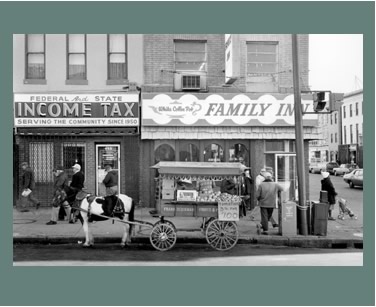
Photo credit:
An Arabber's wagon parked at Broadway near Fells Point.East Baltimore, MD, March 1980. http://tgcd.org/imgs/exh/5_6.jpg
My research proposal topic that I will be conducting research on for the class will be on the history of “Baltimore Arabbers” and the role they played in the growth of Baltimore City. I will attempt to explore the life of this old tradition in Baltimore City neighborhoods that is slowly disappearing. The days of horse and wagon street vendors riding through the block selling different items was one of the customs that made Baltimore what it is today. I chose this topic because it reminds me of one of my first experiences I had of “culture shock” being a kid from New York adjusting to life in Baltimore. The horse and wagons layered with their own style of decorated fruits and vegetables and the arabbers with their distinct sounds are things that separated one from the other.
I think this topic will contribute to the class’s understanding of Baltimore’s history by explaining and presenting information that helps you understand where the roots of a Baltimore tradition started from and where it stands today. I will try to put a face to the people many of us may see or ride past daily but never stop to realize where these different street venders come from. Those that may or may not be familiar with “Baltimore Arabbers” need to know that there is an interesting history behind the old horse and wagons you see strolling through the streets of Baltimore.
Subscribe to:
Posts (Atom)